![[back]](/assets/home_24dp_E3E3E3_FILL0_wght400_GRAD0_opsz24.svg "[back]")
![[search]](/assets/search_24dp_E3E3E3_FILL0_wght400_GRAD0_opsz24.svg "[search]")
Orphic Initiatory Cosmology 1400–600 BCE
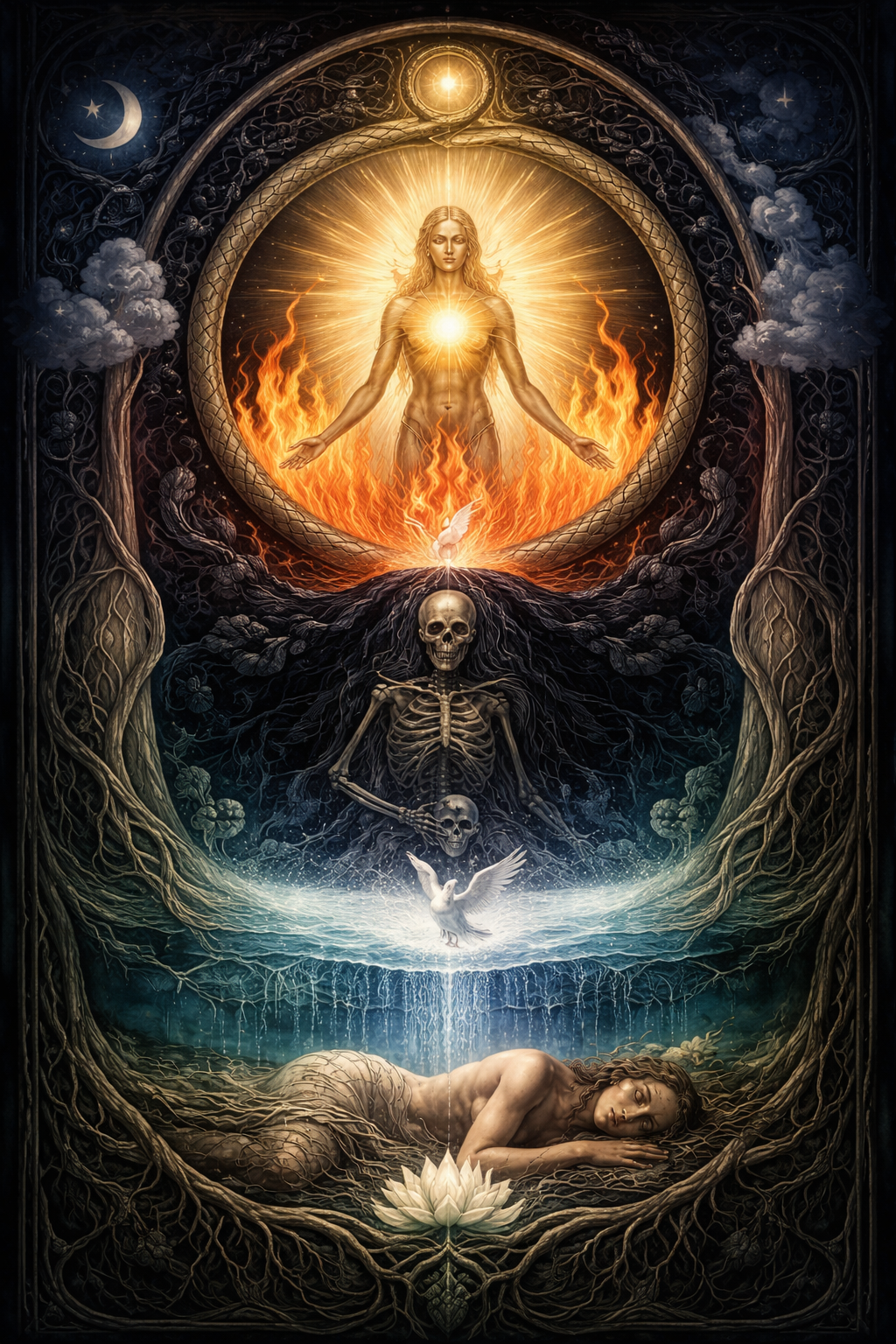
How to change your mind
from Gaia to Ouranos
Orphic, pre-Platonic, initiatory (cosmology as ritual- or inner-mental psychology)
Later Hermetic and alchemical systems inherit and technicalize it.
- Introduction
- Orphic Gold Tablets - I am a child of Gaia and starry Ouranos
- Orphic Initiatory Cosmology (1400–600 BCE)
- Hermetic and alchemical traditions (300 BCE – 300 CE)
- See Also
Introduction
“Orphic” does not name a single founder, author, or school in the later philosophical sense. It is a retroactive designation applied by Greeks themselves to a ritual–initiatory current associated with the figure of Orpheus. Orpheus is not best understood as a historical individual but as a culture-hero: the emblematic voice of a priestly tradition concerned with initiation, purification, death-descent, and the re-ordering of the psyche.
Ancient sources already treat “Orphic” material as older than Homer and belonging to a stratum of ritual knowledge transmitted through hymns, theogonies, lamellae, and rites rather than through authored texts. In that sense, Orphic names a mode of cosmology and psychology, not a biography.
The tradition appears to crystallize in the Late Bronze Age–Early Iron Age Aegean and northern Greek world, roughly ca. 1400–1100 BCE, with strong associations to Thrace, Macedon, and the wider Aegean–Anatolian interface. These are marginal zones—culturally Greek but peripheral to later classical centers—where ecstatic ritual, music, pharmaka, and where initiatory death&resurrection practice intermingled. What we later call “Orphic” likely emerged from priestly and initiatory groups who specialized in rites of purification, controlled crisis, death-symbolism, and re-integration - precisely the process dynamics outlined here as Gaia → Fire → Aion → Ouranos.
It “caught on” not as a mass religion but as a portable initiatory technology, attractive to those seeking liberation from fate, fear, and post-mortem anxiety: itinerant ritual specialists, aristocratic households, mystery-seekers, and later urban initiates.
By the Archaic and Classical periods, Orphic cosmology had diffused widely without becoming institutional. It influenced Pythagorean circles, Eleusinian language, lyric poetry, and later philosophical reflection, while remaining deliberately fragmented and encoded. That fragmentation is not evidence of incoherence; it is evidence of ritual secrecy and adaptability. When open initiation became difficult or dangerous, the same framework survived by being renamed and re-expressed - first philosophically (Platonism, Hermeticism), then technically (alchemy). Thus “Orphic” is best understood as the earliest Greek name for an initiatory cosmology whose core concern was the transformation and ordering of the inner cosmos, long before it was ever written down as doctrine.
Orphic Gold Tablets - I am a child of Gaia and starry Ouranos
The 'Orphic' gold tablets, tiny scraps of gold foil found in graves throughout the ancient Greek world, are some of the most fascinating and baffling pieces of evidence for ancient Greek religion.
Tablets are approximately 4th–2nd century BCE (some possibly earlier)
αὐτὰρ ἐμοὶ γένος οὐράνιον· τόδε δ’ ἴστε καὶ αὐτοί.
“I am a child of Gaia and starry Ouranos;
but my race is of Ouranos - and this you yourselves know.”
It reflects Orphic cosmology: the psyche/soul lives in earthly form, and through initiation it can remember its divine origin.
These tablets were placed in graves and contain short ritual instructions for the soul after death. Intended for the deceased to speak when encountering entities in the underworld. We can also extrapolate how this could be used during an initiation, as well.
see Orphic Gold Tablets for more
Orphic Initiatory Cosmology (1400–600 BCE)
Archaic Greek Mystery Cosmology was active as a ritual and initiatory system from roughly 1400–600 BCE, but its structures persist far beyond that period in textual, symbolic, and technical echoes - notably in the Greek Septuagint, Hermetic literature, and later alchemical traditions. After 600 BCE the framework is no longer primary, but remembered, encoded, and systematized into later frameworks like Eleusis, Dionysiac rites, etc).
NOTE: This is a initiation framework, from the Orphic Cosmic Egg cosmogony.
- Gaia names the grounded mental mode of life - memory, hunger, fear, and cyclical time (weight and repetition rather than freedom or order), lower psyche/soul (ψυχή) bound to body (soma/σῶμα)
- Ouranos names the upper ordering intellect, upper νοῦς, the mode of mind in which perception is lifted from hunger and fear into pattern and proportion, and time is experienced as clarity and openness rather than weight and repetition.
- Initiatory Fire - a mental operation and process that “cooks off” or "cracks the egg" of rigid identity and habitual fear, dissolving the biases that govern ordinary perception.
- Fire forges the mind, as a metal is forged - by heat that dissolves rigidity so a new structure can form.
- Aionic perception - emerges from that Fire, a mode of mental presence that sees without being pulled into past, future, or identity narratives. From this non-reactive presence, Ouranic ordering becomes possible, allowing intentional harmonious reordering of psyche/soul between the Gaian (low: fear-bound, reactive) and Ouranic (high: trust-based, ordered) mental modes into a "divine mind" (Theos/θεος: personal mind like the divine) a harmoniously ordered inner "domain/kingdom" (basileía / βασιλεία).
- Aionic life: stabilized non-reactive continuity and sustained mental presence.
- In the transition from Gaia → Ouranos, the primary shift is that fear stops governing action.
- mystery initiation moves the subject's mentality from Gaia-bound perception through exposure (know thyself), dissolution (shed identity and fear), separation (structure survives, fear burns off) - toward a reorientation to Ouranic order - intelligent, constructive, coherent, non-reactive - without abandoning the mental Gaian grounding that sustains life. The result is not escape from Gaia mind, but integration under a higher order.
- Gaia names the condition of life (consciousness) governed by weight, need, and return. It is the ground that pulls downward, demands feeding, remembers through habit and injury, and repeats through cycles of growth and decay. As a mode of mind, Gaia is the state in which perception is shaped by hunger, fear, fatigue, and memory before reflection is possible. Time in Gaia is heavy and repetitive, bound to season and consequence. This is not abstraction but necessity: the mental world of survival, reproduction, trauma, and continuity. Gaia does not order or calculate; she compels and endures.
- the necessary ground for initiation: one must descend fully into Gaia (mortality, terror, dissolution) before ascent toward Ouranos is possible
- Ouranos names the condition of life (consciousness) governed by pattern, distance, and ordering rather than weight or need. It is not transcendence but the suspension of fear as the governing force of action, making constructive choice possible. It is the realm that lifts perception away from immediacy, where hunger loosens its grip and fear no longer dictates response. In the Ouranic mode, things are seen whole—relations, proportions, causes, limits. Thought precedes reaction; choice interrupts habit. Time here is not heavy or cyclical but open and suspended, experienced as clarity, pause, or simultaneity rather than repetition. This is not escape from life but re-orientation of it: the mental world of structure, measure, foresight, and intelligibility. Ouranos does not compel or endure; he orders, separates, and makes visible, allowing what is confused in Gaia to be grasped, named, and aligned.
- The initial function of the Ouranic mode is not transcendence but the suspension of fear as the governing force of action, an Aionic perception making constructive choice possible. So that:
- pharmakon be administered safely (from a place of trust, without descending into fear)
- visions be interpreted (from a place of trust) rather than obeyed (from a place of fear)
- action become aligned (from a place of trust) rather than impulsive (from a place of fear)
- Bottom Line: without panic or loss of interpretive control
- After fear has been suspended as the governing force, the Ouranic mode shifts from stabilization to ordering. In its later phase, Ouranos does not merely calm the system; he restructures it. He doesn’t just stop fear; he builds a structure that makes fear unnecessary.
- experience is integrated into models
- memory is reorganized
- future action is planned rather than improvised
- the self regains orientation in the whole
- Fear dissolves not because it’s suppressed, but because the system now understands what it’s dealing with.
- Phanes as the personification of Aionic emergence
- Phanes is an event: Light, First appearance, Unity, Consciousness becoming visible to itself. Phanes does not act as a process. Phanes appears as an event.
- Phanes is what emerges when the egg opens. It's Initiatory Fire cracking identity, Emergence of Aionic presence, Suspension of fear, Conscious ordering (Ouranos). That Aionic emergence is functionally identical to Phanes.
- the initiatory moment when awareness becomes luminous to itself
- Phanes = the appearance of light within Aion
- Phanes = the “first seeing” after identity collapse
- Phanes = consciousness realizing it is conscious
- Chronos → compulsive narrative time, memory loops (Gaia-time)
- Ananke → inevitability, fear-driven necessity
You can also see the Ouranos and Gaia framework used in the 290BCE Genesis text.
Hermetic and alchemical traditions (300 BCE – 300 CE)
- see also Hermeticism
In Hermetic and later alchemical traditions, the Orphic initiatory cosmology does not change in substance, but changes in expression. What was once enacted through communal ritual, ordeal, and guided initiation is preserved in symbolic, technical, and deliberately opaque forms. For alchemy, the same inner dynamics remain, but they are encoded, hiden from the public.
Hermetic texts translate the Orphic framework into a philosophical–psychological register. Alchemy translates it further into a material–procedural register. In both cases, the aim is continuity of transmission under conditions where open initiatory practice was no longer possible or safe. Obscurity is not confusion; it is protective concealment.
The “egg” of Orphic cosmology becomes the vessel. Initiatory Fire becomes putrefaction and heat. Ouranic ordering becomes separation and clarification. Aionic stabilization becomes fixation and circulation. These are not new stages, but technical restatements of the same initiatory sequence, expressed in a language that could survive philosophical scrutiny, political suppression, and religious persecution.
Alchemy, in particular, deliberately masks inner psychological operations as material processes, allowing the tradition to persist under hostile authorities. The laboratory is not the goal; it is the cover.
Hermetic framing (psychological–philosophical encoding)
- Gaia-mode → bondage to fate (life governed by necessity and reaction)
- Initiatory Fire → crisis, dissolution, and shock that breaks identification with fate and compulsion
- Aion → aionic life (stabilized presence beyond fate)
- Ouranos-mode → awakening of nous (ordering intelligence)
Alchemical framing (material–procedural encoding)
- Gaia → prima materia, chaos, weight, nigredo
- Initiatory Fire → heat, putrefaction, exposes / intensfies / dissolves nigredo
- Aion → fixation, circulation, rubedo
- Ouranos → separation, clarification, albedo
What appears in Hermetic and alchemical traditions is therefore not a new cosmology, but the same Orphic initiatory dynamics, preserved, formalized, and made repeatable outside their original ritual settings, under conditions that demanded concealment rather than proclamation.
Alchemical example that explicitly links inner transformation, fire, and stages of matter:
(Preserved in Greek fragments; standard editions: Berthelot–Ruelle)
μέλαινα γὰρ γίνεται ἡ ὕλη πρῶτον, εἶτα λευκαίνεται, καὶ τέλος ἐρυθραίνεται διὰ πυρός.
For the matter first becomes black, then it is whitened; And completion happens through the process of reddening by fire.
Elsewhere:
ἡ γὰρ τέχνη ἡμετέρα ψυχικὴ ἐστίν
“For our art is of the soul.”
- hule (ὕλη) (matter) → the initiate’s psyche/soul (ψυχή) still bound to Gaia/nigredo
- reddening (ἐρυθραίνεται) dia puros (διὰ πυρός) (through fire) → Fire as transforming agent
- melaina (μέλαινα) (blackening) → exposing and then dissolving Gaia/nigredo
- leukainetai (λευκαίνεται) (whitening) → ordering follows after exposure and dissolution, albedo
See Also
- Cosmic Egg - a model of rebirth during your life, expressed as creation myths, across cultures.
- Aionic Life - mental realm of presence, timelessness
- Initiatory Fire - pressure process to crack that egg, expose and dissolve identity, to enter the aion in order to move the psyche/soul towards Ouranic ordering
- saba chthanie - "awe, o chthonic mother", famous last words, evidence of invoking Hipta during descent?
- Hermeticism